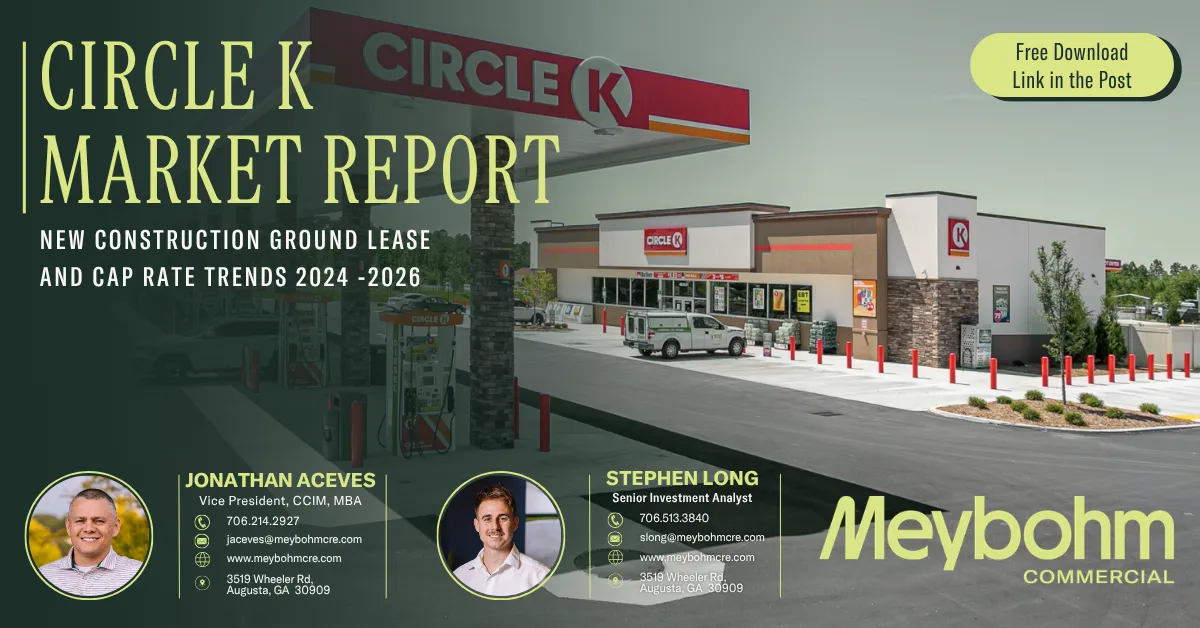
Understanding Circle K Ground Lease and Cap Rates Trends in the Current Market
Click here to Download the Market Report
Backed by Alimentation Couche-Tard's dual investment-grade credit ratings (BBB+ / Baa1, both Stable), Circle K ground leases represent one of the most liquid and institutionally favored assets in the net lease convenience sector. This report explores cap rates for new-construction Circle K ground leases, focusing on their performance in the capital markets. The analysis includes 26 Circle K ground leases built in 2024 or later — 11 that have sold and 15 currently available on the market.
Key Findings:
Cap Rate Trends: The data indicates a gradual compression in cap rates for Circle K ground leases over the study period:
2024: Average sold cap rates of 5.36%.
2025: Cap rates compressed by 16 basis points to 5.20%.
2026: Cap rates have stabilized around 5.22%, suggesting the market has found an equilibrium for new-construction Circle K ground leases in the low 5% range.
This trend is notable given the broader interest rate environment, where many net lease asset classes have seen cap rate expansion. Circle K's compression reflects growing investor confidence in the tenant's credit profile and operational momentum — including three consecutive quarters of positive same-store sales and 18.1% net earnings growth in Q3 FY2026.
On-Market Cap Rates: Despite sold comps averaging in the 5.20–5.36% range, the average on-market asking cap rate sits at approximately 4.88%. Most on-market listings are priced at or near 5.00%, with several aggressive listings in the high 4% range (4.50–4.75%). This suggests that sellers are attempting to position their properties below recent closed benchmarks, banking on the strength of Circle K's credit and the scarcity of new-construction investment-grade ground leases. However, the ~32 bps spread between asking and sold cap rates indicates that buyers are likely to push back, with execution expected closer to the 5.00–5.25% range.
Market Dynamics: Circle K ground leases occupy a middle ground in the net lease convenience spectrum — trading tighter than non-rated regional operators but wider than trophy tenants like Chick-fil-A or McDonalds. The investment-grade rating provides institutional buyers with a tenant profile that checks the credit box, while the 5%+ cap rate offers meaningfully better yield than sub-4% alternatives in the quick-service restaurant space. This yield advantage, combined with Couche-Tard's $72.9 billion revenue base and 17,300-store global footprint, positions Circle K as a compelling risk-adjusted option for ground lease investors.
Pad size shows a strong inverse correlation to rent per acre, with smaller traditional sites (1.9 acres) commanding significantly higher per-acre rents ($87K/acre) than larger HSD sites (~3.6 acres, ~$62K/acre). However, total rent per site remains remarkably stable at $177K–$181K across all years, suggesting the market has established a tight band for what institutional buyers expect as a starting NOI on a Circle K ground lease. This ceiling is likely driven not just by investor pricing but by what Circle K can realistically pay in ground rent while still hitting its internal return hurdles on a new-build store. For most traditional stores, total rent tops out near $200K — only 3 of 21 traditional sites exceeded that threshold, and all three were in Florida.
Conclusion:
New-construction Circle K ground leases have moved through their repricing phase and settled into a stable equilibrium in the low 5% range. Sellers are aggressively pricing on-market listings in the high 4% range, but execution data suggests buyers should expect to transact at 5.00–5.25%. Combined with Couche-Tard's strengthening operational performance, investment-grade credit, and a stated goal of adding 750 company-operated locations over the next five years, Circle K ground leases are well-positioned to remain a core holding for net lease investors.
Stephen Long, Senior Investment Analyst
Jonathan Aceves, Vice President, CCIM, MBA
