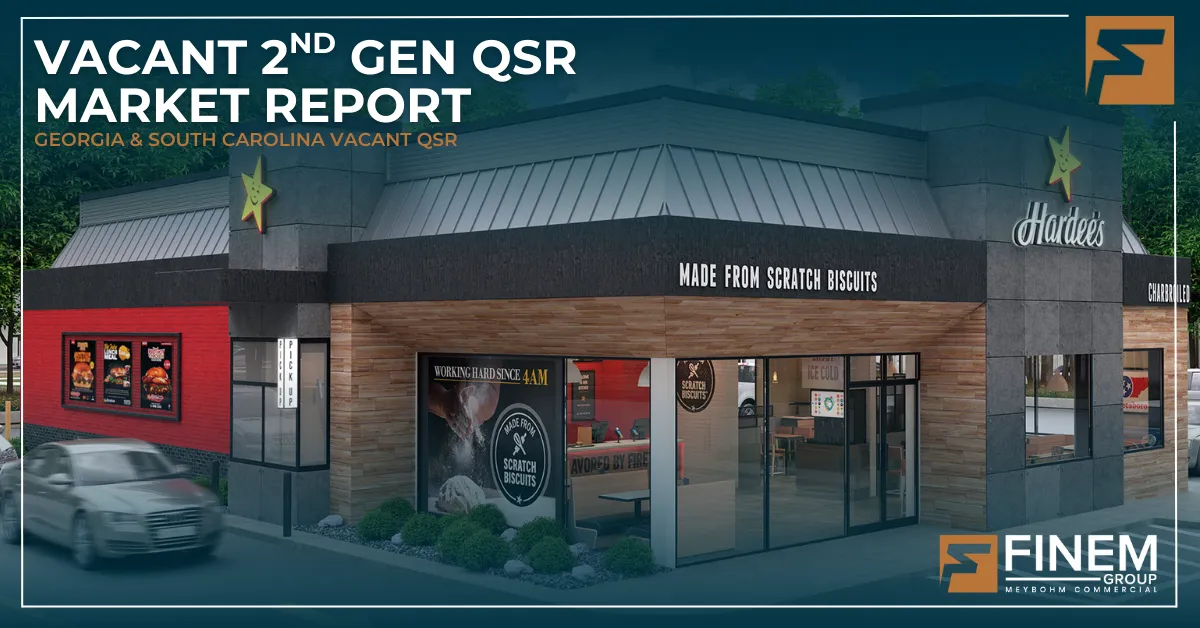
Dark QSR Market Report
What the Market Is Telling Us About Vacant Second-Generation QSR Buildings
Click here to download the market report
The recent wave of franchise consolidations and bankruptcies have created a noticeable uptick in vacant second-generation quick-service restaurant properties across Georgia and South Carolina. Rather than signaling distress across the sector, the data suggests something more nuanced: these assets are entering a transition phase, and many remain highly viable investments when properly positioned.
Our latest market analysis examined transactions involving vacant QSR buildings constructed in 2000 or later, covering activity from 2023 through early 2026. The dataset included 14 closed sales and 10 active listings, providing a clear snapshot of pricing trends, buyer behavior, and forward-looking market expectations.
Pricing across the study period showed meaningful range but consistent demand. Average sale prices fell between approximately $1.68 million and $2.16 million, while price per square foot ranged from $406 to $938. While building condition and age played a role, location emerged as the single strongest factor influencing value. Properties in stronger retail corridors and larger markets consistently achieved higher pricing metrics, reinforcing the long-standing principle that site fundamentals ultimately drive performance.
Buyer composition was also telling. Every transaction analyzed involved a purchaser planning to reuse the existing structure rather than acquire the property strictly for land value. Of those buyers, roughly 64 percent were end users, while 36 percent were developers intending to lease the building to a future tenant. This indicates that despite closures, these buildings still meet operational needs for many restaurant concepts and service users.
Looking ahead, inventory is expected to increase as additional franchise closures bring more properties to market. Even so, projected 2026 transaction volume is anticipated to surpass 2024 levels as supply expands and investors continue to pursue these assets. Importantly, rising construction costs, increasing land values, and limited new development supply are reinforcing demand for existing buildings as a cost-effective alternative to ground-up construction.
A recent case study illustrates how strategic repositioning can unlock value. A vacant Golden Corral property in Aiken, South Carolina was ultimately repositioned through a negotiated ground lease with a national restaurant tenant, resulting in an approximate $3 million value outcome for the owner. Rather than pursuing a traditional sale, the ownership leveraged location strength and targeted marketing to maximize returns.
The takeaway is clear: vacant second-generation QSR properties should not automatically be viewed as distressed or obsolete. In many cases, they represent flexible, infrastructure-ready assets that can meet current user demand at a lower cost basis than new construction. For owners and investors willing to analyze positioning, tenant demand, and market dynamics, these properties can present meaningful opportunity in today’s evolving retail landscape.
If you suspect a tenant may be going dark, early strategy matters. Our approach typically begins with a VOID analysis to understand true site potential, then works backward through brand AUV rankings from highest to lowest to identify the strongest prospective backfill tenants. Starting this process before vacancy occurs often preserves value, shortens downtime, and positions the asset for the most competitive outcome.
